Blackjack Master Chart
Each decision you make while playing blackjack has a positive or negative
impact on your potential profit or loss. Every situation you have while playing
has a single best way to play.
A blackjack strategy chart tells you exactly which plays to make based on what the dealer is showing, the cards you’re dealt, and the number of decks used in the game. If you take some time to examine the chart, you will notice that it is really quite simple to follow. Note: Always stand on a soft 18 or higher to increase your odds of winning. Blackjack Master 3 is the best blackjack experience available for Windows 8. Featuring fast paced blackjack action with correctly implemented rules, this will be the last blackjack app you ever download! Worried about missing features or rules? However, there are a few basics that you can master rather easily. The biggest help for you will be to use a blackjack strategy chart. We made it possible to find room in this article to publish an in-depth chart, you can download this in-depth chart on the link above. This chart just print out in concrete form what skilled players recognize as. Learn how to beat the house with card counting from the pros who've won millions. The best resource for card counting training, community, and info. The advanced hard doubling down chart (i.e., when to double down on hard 11, 10, 9, 8, etc. Using the normalized count by comparing it with the number that the computer has given.) The advanced splitting chart if doubling after splitting is allowed.
If you make the correct play it either makes you the most money in the long
run or loses the least amount of money in the long run. This is called basic
strategy.
Some hands lose money in the long run and some win in the long run, so your
job is to make the best possible play to maximize the wins and minimize the
losses.
When you read about the expected house edge in blackjack games based on the
rules the percentages are based on perfect basic strategy. If you don’t use the
proper strategy you give the house a higher edge against you. This can add an
extra one or two percent to the house edge, depending on how far from the proper
strategy you stray.
You can usually find blackjack games with rules that offer a house edge of
less than 1%, and can often find games with a house edge under a half percent.
If you don’t use basic strategy you can be playing with a house edge of 1.5% to
3% instead of a half percent.
This quickly adds up.
Here’s an example:If your average bet is $100 and you play 100 hands per hour and you give the
casino and extra 1% you lose an extra $100 per hour. By giving them an extra 2%
it’s $200 per hour.
If you want to play blackjack the first thing you need to do is decide to
always make the best possible play.
You probably realize that there are hundreds of hands when you combine all of
the possible hands you can have with the different up cards the dealer can have.
The good news is that by using a simple chart you can quickly find the best
play. And you can use a strategy chart or card at the table while playing in a
live casino or when playing online.
If you play in a live casino some of the other players may try to pressure
you if you take too long to make a decision. But it’s none of their business and
you can play any way you want as long as you don’t hold up the game too long.
If you’re worried about holding up the game sit in the middle of the table or
to the dealer’s right hand side so you have longer before you have to act. This
gives you more time to consult your strategy chart before being force to make a
decision.
You don’t even need to memorize the best plays.
But with a little effort and time you can quickly memorize the most common
plays and in time memorize all of the best plays.
The next section has a chart and the following section has the hand by hand
explanations. Then you’ll find a section explaining a few ways to start
memorizing all of the plays.
Basic Strategy Chart
This is the most universal basic strategy chart and can be used in all
blackjack games with any rule combinations. A few small adjustments can be made
against certain rules combinations, but it becomes complicated to memorize
multiple charts. We’ve included a short section later explaining these
adjustments for the dedicated player.
The dealer’s up card is listed across the top. Your cards are listed down the
first column to the left. Simply go down the left column until you find your
cards and then go across to the column with the dealer’s card to find the best
play.
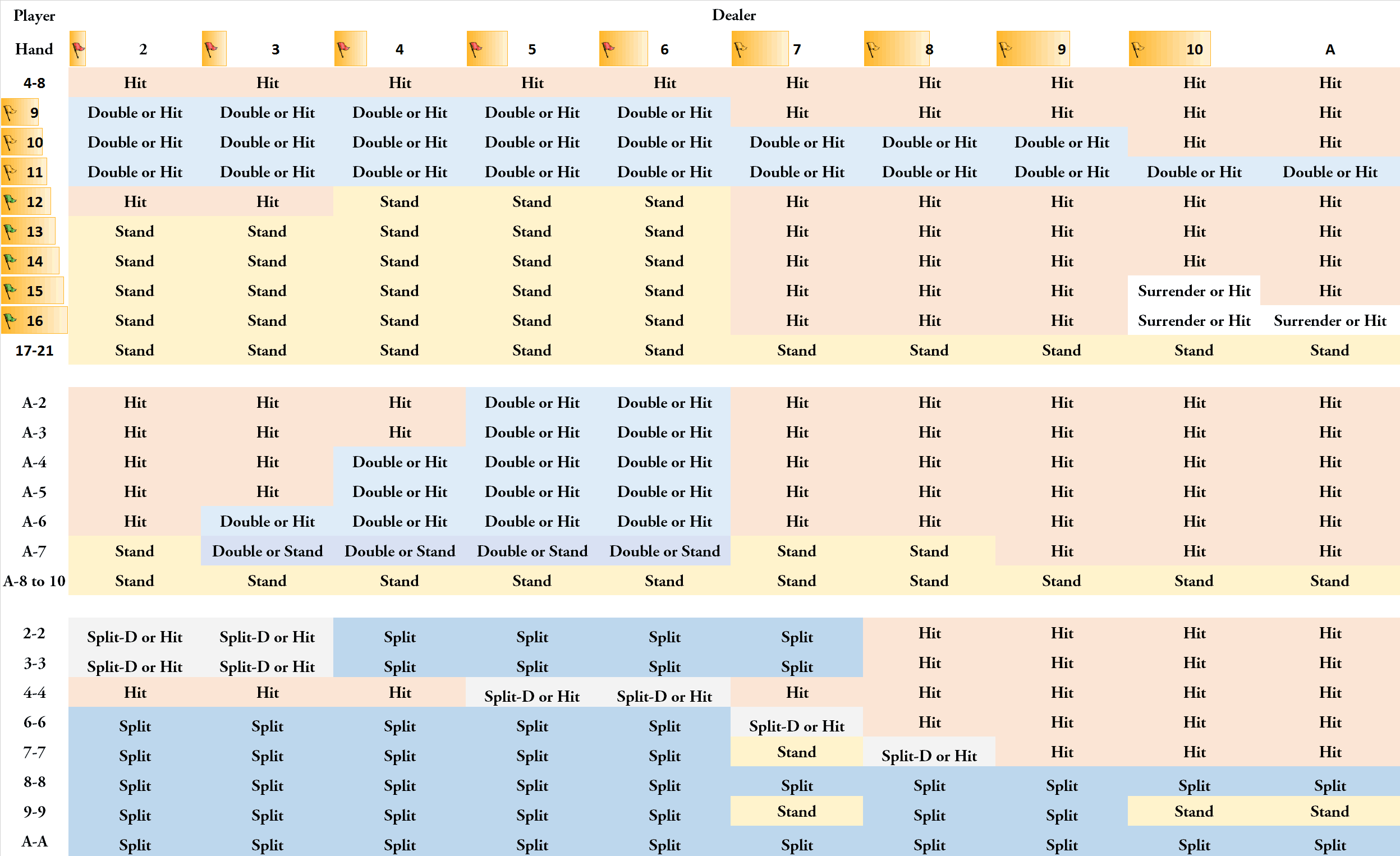
The key for each play is as follows:
- Hit – Hit
- Stand – Stand
- DblH – Double
- DblS – Double if permitted, otherwise stand
- Split – Split
- SplitD – Split if double after split is permitted, otherwise hit
- SUR – Surrender if permitted, otherwise hit
| Your Hand | Two | Three | Four | Five | Six | Seven | Eight | Nine | 10 | Ace |
|---|---|---|---|---|---|---|---|---|---|---|
| 2 – 2 | SplitD | SplitD | Split | Split | Split | Split | Hit | Hit | Hit | Hit |
| 3 – 3 | SplitD | SplitD | Split | Split | Split | Split | Hit | Hit | Hit | Hit |
| 4 – 4 | Hit | Hit | Hit | SplitD | SplitD | Hit | Hit | Hit | Hit | Hit |
| 5 – 5 | DblH | DblH | DblH | DblH | DblH | DblH | DblH | DblH | Hit | Hit |
| 6 – 6 | SplitD | Split | Split | Split | Split | Hit | Hit | Hit | Hit | Hit |
| 7 – 7 | Split | Split | Split | Split | Split | Split | Hit | Hit | Hit | Hit |
| 8 – 8 | Split | Split | Split | Split | Split | Split | Split | Split | Split | Split |
| 9 – 9 | Split | Split | Split | Split | Split | Stand | Split | Split | Stand | Stand |
| 10 – 10 | Stand | Stand | Stand | Stand | Stand | Stand | Stand | Stand | Stand | Stand |
| Ace – Ace | Split | Split | Split | Split | Split | Split | Split | Split | Split | Split |
| Two | Three | Four | Five | Six | Seven | Eight | Nine | 10 | Ace | |
| Soft 13 | Hit | Hit | Hit | DblH | DblH | Hit | Hit | Hit | Hit | Hit |
| Soft 14 | Hit | Hit | Hit | DblH | DblH | Hit | Hit | Hit | Hit | Hit |
| Soft 15 | Hit | Hit | DblH | DblH | DblH | Hit | Hit | Hit | Hit | Hit |
| Soft 16 | Hit | Hit | DblH | DblH | DblH | Hit | Hit | Hit | Hit | Hit |
| Soft 17 | Hit | DblH | DblH | DblH | DblH | Hit | Hit | Hit | Hit | Hit |
| Soft 18 | Stand | DblS | DblS | DblS | DblS | Stand | Stand | Hit | Hit | Hit |
| Soft 19 | Stand | Stand | Stand | Stand | Stand | Stand | Stand | Stand | Stand | Stand |
| Soft 20 | Stand | Stand | Stand | Stand | Stand | Stand | Stand | Stand | Stand | Stand |
| Soft 21 | Stand | Stand | Stand | Stand | Stand | Stand | Stand | Stand | Stand | Stand |
| Two | Three | Four | Five | Six | Seven | Eight | Nine | 10 | Ace | |
| Hard 4 | Hit | Hit | Hit | Hit | Hit | Hit | Hit | Hit | Hit | Hit |
| Hard 5 | Hit | Hit | Hit | Hit | Hit | Hit | Hit | Hit | Hit | Hit |
| Hard 6 | Hit | Hit | Hit | Hit | Hit | Hit | Hit | Hit | Hit | Hit |
| Hard 7 | Hit | Hit | Hit | Hit | Hit | Hit | Hit | Hit | Hit | Hit |
| Hard 8 | Hit | Hit | Hit | Hit | Hit | Hit | Hit | Hit | Hit | Hit |
| Hard 9 | Hit | DblH | DblH | DblH | DblH | Hit | Hit | Hit | Hit | Hit |
| Hard 10 | DblH | DblH | DblH | DblH | DblH | DblH | DblH | DblH | Hit | Hit |
| Hard 11 | DblH | DblH | DblH | DblH | DblH | DblH | DblH | DblH | DblH | Hit |
| Hard 12 | Hit | Hit | Stand | Stand | Stand | Hit | Hit | Hit | Hit | Hit |
| Hard 13 | Stand | Stand | Stand | Stand | Stand | Hit | Hit | Hit | Hit | Hit |
| Hard 14 | Stand | Stand | Stand | Stand | Stand | Hit | Hit | Hit | Hit | Hit |
| Hard 15 | Stand | Stand | Stand | Stand | Stand | Hit | Hit | Hit | SUR | Hit |
| Hard 16 | Stand | Stand | Stand | Stand | Stand | Hit | Hit | SUR | SUR | SUR |
| Hard 17 | Stand | Stand | Stand | Stand | Stand | Stand | Stand | Stand | Stand | Stand |
| Hard 18 | Stand | Stand | Stand | Stand | Stand | Stand | Stand | Stand | Stand | Stand |
| Hard 19 | Stand | Stand | Stand | Stand | Stand | Stand | Stand | Stand | Stand | Stand |
| Hard 20 | Stand | Stand | Stand | Stand | Stand | Stand | Stand | Stand | Stand | Stand |
| Hard 21 | Stand | Stand | Stand | Stand | Stand | Stand | Stand | Stand | Stand | Stand |
| Two | Three | Four | Five | Six | Seven | Eight | Nine | 10 | Ace |
Expand Shrink
Text Version and Vision Impaired
Many players use the chart listed above but a few players prefer to read the
correct plays. Having the correct plays written out also is valuable to people
who have vision problems and use software to hear what’s on the page.
We’ve listed the proper plays for each situation below in four sections.
Simply find the section that describes your hand and follow the instructions.
Hands with an Ace or Soft Hands
Any starting hand you hold with an ace is called a soft hand. A soft hand is
when you have an ace that can be used as a one or 11. In the following
combinations, if you have more than two cards, simply add the cards that aren’t
an ace.
This can happen when you start with an ace and a different side card and hit.
Starting with an ace two and receiving a four after hitting leaves you with ace
two four. Looking at the chart you look at the line for a soft 17. Using the
list below you look at the one for ace six because the two and four add up to
six.
- Ace ace – Always split a pair of aces. Split aces as many times as allowed.
- Ace two or soft 13 – You always hit with a soft 13 and double if allowed
against a dealer five or six. - Ace three or soft 14 – Always hit and double against a five or six if
allowed. - Ace four or soft 15 – You always hit with a soft 15 and double if allowed
against a dealer four, five, or six. - Ace five or soft 16 – Always hit and double against a four, five, and six if
allowed. - Ace six or soft 17 – Double against a three, four, five, and six if allowed
and otherwise hit. - Ace seven or soft 18 – Stand against a dealer two, seven, and eight, hit
against a nine, 10, or ace, and double if allowed against three, four, five, or
six. - Ace eight or soft 19 – Stand at all times.
- Ace nine or soft 20 – Always stand.
- Ace 10 – Blackjack! Always stand.
Pairs
Whenever you have a pair for your first two cards you need to decide if you
should split.
- Two two – Split against a dealer four, five, six, and seven, hit against a
dealer eight, nine, 10, and ace, and against a dealer two or three split if you
can double after split and hit if double after split isn’t allowed. - Three three – Play your hand exactly the same as two two. If double after
split is allowed split against a dealer two or three, otherwise hit against
these two cards. Hit against a dealer eight, nine, 10, and ace, and split
against a dealer four, five, sis, and seven. - Four four – When double after split is allowed split against a dealer five
and six, otherwise hit. Hit against all other dealer cards. - Five five – Never split fives. Hit against a dealer 10 or ace and double
against all other dealer cards if allowed. - Six six – Hit against a dealer seven, eight, nine, 10, and ace. Split against
a dealer three, four, five, and six. Split against a dealer two if double after
split is allowed, otherwise hit. - Seven seven – Split against a dealer two, three, four, five, six, and seven.
Hit against a dealer eight, nine, 10, and ace. - Eight eight – Always split eights.
- Nine nine – Split against a dealer two, three, four, five, six, eight, and
nine. Stand against a dealer seven, 10, and ace. - Ten ten – Always stand with a total of 20.
- Ace ace – Aces should always be split. If you receive another ace on one of
your split aces you should split again. Do this as many times as possible.
Hard Totals
A hard total is any hand that doesn’t have an ace where you can use it as a
one or 11. In any two card starting hand you can use an ace as either one or 11,
but after you hit one or more times you can reach a total where the ace can’t be
used as an 11 without busting. When this happens you hold a hard hand.
- Hard four – The only hard four is a pair of twos. This is covered in the two
two line under pairs. If splitting isn’t allowed then always hit with a hard
four. - Hard five – Always hit with hard five.
- Hard six – Hit against all dealer cards with a hard six.
- Hard seven – Always hit with a hard seven.
- Hard eight – Hit against all dealer totals with hard eight.
- Hard nine – If double is allowed, double against a dealer three, four, five,
or six, otherwise hit. Hit against all other dealer cards. - Hard 10 – When double is allowed, double against a dealer two, three, four,
five, six, seven, eight, and nine, otherwise hit. Hit against a dealer 10 and
ace. - Hard 11 – Double against any dealer car except an ace if doubling is
permitted, otherwise hit. Hit against a dealer ace. - Hard 12 – Stand against a dealer four, five, and six. Hit against all other
dealer cards. - Hard 13 – Stand against a dealer two, three, four, five, and six. Hit against
a dealer seven, eight, nine, 10, and ace. - Hard 14 – Stand against a dealer two, three, four, five, or six and hit
against seven or higher. - Hard 15 – Against a dealer two, three, four, five, and six you should stand.
Against a dealer seven, eight, nine, 10, and ace you should hit. - Hard 16 – Stand against a dealer total of two, three, four, five, and six.
Hit against all other dealer totals. - Hard 17 – Stand against all dealer hands.
- Hard 18 – Always stand with a hard 18.
- Hard 19 – Stand against all dealer hands.
- Hard 20 – Always stand with a hard 20.
- Hard 21 – Stand against all dealer totals.
Surrender
If surrender is allowed you should surrender with a hard 15 against a dealer
10 and with a hard 16 against a dealer nine, 10, or ace. If surrender isn’t
allowed then hit in these four situations.
Adjustments for Different Rules
The chart and instructions above are designed for a game where the dealer
stands on a soft 17. If you play in a game where the dealer hits on a soft 17
you can make the following adjustments.
As we mentioned above, it can be complicated to keep two different charts
straight in your mind so learning the first chart is best. However, there are
only six hands that change so it’s possible to learn and use the differences.
Split hands
Instead of splitting eight eight against a dealer ace,
surrender if allowed, otherwise split.
Soft hands
With a soft 18 against a dealer two and with a soft 19 against a
dealer six double if allowed, otherwise stand.

Hard hands
With a hard 11 against a dealer ace double if allowed, hit
otherwise. With a hard 15 against a dealer ace surrender if permitted, otherwise
hit. With a hard 17 against a dealer ace, surrender if permitted and otherwise
stand.
Insurance or Even Money
Notice that there’s not a single hand that recommends taking insurance or
even money. This is because taking insurance is always a losing proposition.
When the dealer has an ace showing you have the option of making another bet
equal to the size of your first bet that pays two to one if the dealer has a 10
hole card. If you take insurance and the dealer has a 21 you lose your first bet
but get double on your second so you break even.
But when the dealer doesn’t have 21 you lose the insurance bet and your first
bet plays out as normal.
On the surface this may seem like a good bet, but a simple look at the math
behind the bet shows why you should never take insurance.
When the dealer has an ace showing she has a blackjack any time a 10, jack,
queen, or king is her down card. This means four of the 13 possible cards pay
off on the insurance bet.
But this also means that the other nine cards, two through nine and ace, make
you lose the insurance bet. This is a ratio of nine to four, with nine losing
cards and four winning cards. But the bet only pays two to one.
The odds of nine to four is worse than two to one, so it’s a losing bet.
When To Hit In Blackjack Chart
Forget your normal hand because it doesn’t have anything to do with the
insurance offer. Insurance is just a bet on what the dealer has as a down card.
And since it’s offered at bad odds you can now see that it should be avoided.
This is just another way the casinos try to be sneaky and build a bigger long
term edge against you.
How to Memorize Basic Strategy
The easiest way to start memorizing basic strategy is to use the chart
provided above to make every playing decision. As you play you’ll start
recognizing the correct play for most hands before checking your chart.
Sign up for a free account at one of our recommended online casinos and start
playing the free blackjack games. You can play over 100 hands per hour in most
cases so you can get a great deal of practice in a short amount of time.
Eventually you’ll only need to check your chart on the most difficult plays
and if you play long enough all of the plays will come from memory.
The other way is more difficult for most players, but if you have a strong
mind for memory you can simply start memorizing the chart.
A quick tip is to group similar hands together.
Here’s an example:All of the hard hands totaling four, five, six, seven, and eight are played
the same way. On all of these hands you always hit. If you’re playing a game
where doubling isn’t allowed, you can add all of the hard totals of nine, 10 and
11 to this. As a side note, you should avoid games where doubling isn’t allowed
as they have a higher house edge.
Other easy to learn hands include:
- Always split aces and eights.
- Soft 13 and 14 are played the same.
- Soft 15 and 16 are played the same.
- Soft 17 only has one dealer card played differently than soft 15 and 16.
- Hard 13, 14, 15, and 16 are played the same unless surrender is allowed.
- Hard 10 and 11 are the same except for one dealer card.
- Two two and three three are played the same.
- All of the hard totals 17 and above are played the same.
- All of the soft totals of 19 and above are played the same.
The majority of hands are hard hands and the complete hard hand strategy is
fairly simple. Memorize it first and you’ll find that you won’t need to refer to
the chart often.
The next chart to memorize after you’ve mastered the hard hands is the soft
hands. Most of them are straightforward as well, with the main changes of
knowing when to double down.
Once you have the hard and soft hands memorized the splits will come easy to
finish out your mental chart. You only need to learn the split rules for twos,
threes, fours, sixes, sevens, and nines.

Blackjack Master Charters
The main thing is to not be afraid that you can’t learn the chart and to get
started right away. Almost anyone can improve their results and reduce the house
edge with a small amount of effort and time.
Card Counting

If you learn how to count cards you can play with a small edge against the
house while playing blackjack. This page is about basic strategy so we aren’t
going to dig into the realm of card counting, but it does have quite a bit to do
with basic strategy.
Card counters learn perfect basic strategy before they start trying to learn
about counting. If you can’t put in the work to learn perfect strategy you have
no hope of being a successful card counter.
Once you master basic blackjack strategy then you should investigate card
counting to see if it’s something you might want to learn. Counting cards online
won’t get you an edge because the software shuffles the cards after each deal,
but if you play live it might be able to help you win or at least play a break
even game.
Conclusion
Learning and using blackjack basic strategy gives you the best chance to win.
It reduces the house edge as much as possible and helps you have more winning
playing sessions.
Most players don’t take the time to learn basic strategy, but if you use the
information above you can quickly start using the best play for every situation.
Use the tips in the how to memorize basic strategy section and you’ll be a
master in no time.
And don’t forget to use the chart provided as you’re learning. Once you get
used to it you can find the proper play in a second or two.
Blackjack is a highly popular casino table game, and if you’re familiar with it already, you’ve probably heard of card counting and the ways in which it can help you achieve those big wins! Once you’ve got an effective strategy together, you can (realistically) gain an advantage over the house of somewhere between one and two percent. Want to know how it’s done? Take a look at our quick guide below!
#1. Learning the Basic Strategy
If you’re interested in winning money by counting cards, you need to be on top of your decision-making skills. Blackjack is actually quite different from other casino games, because it requires the player to constantly make decisions, of which ‘hit or stand?’ is the most well known. These decisions are the key to beating the dealer, and as such, in order to come out on top you need to be able to make the best decisions based on facts and probabilities at any given moment.

To give a quick example: many beginner players will choose to ‘hit’ on 12 vs 5 or 6, in the assumption that their gamble is a safe one. Actually, when you look at the real mathematical probability, this is the wrong choice: you have a thirty percent chance of then drawing a ten, and thus going bust and losing your cash. On top of this, the dealer’s probability of going bust would also have been quite high.
Going ahead with a badly thought out strategy, and not being away of basic probability, is always going to lead to disaster, and will make card counting totally pointless. Get yourself a guide to basic strategy, learn it well, and then approach card counting as the next logical step.
#2. Do Your Homework
One thing is for sure: you need to be able to memorize the strategy before you go out in the field, and try it for real. You also need to have gotten your head around the theory the strategy is based on, in order to have the flexibility real life situations often demand. Certain card counting systems are pretty easy to learn, and simple to replicate – Hi-Lo is a great example, and in this system, cards are given the following values:
As each card gets dealt at the Blackjack table, you need to keep a running count. Remember: high totals are good for you (the player), as it means that the shoe still contains plenty of aces, picture cards and 10s… and that means the following outcomes are far more likely to come out:
● The player receives a blackjack deal: paid out at 3 to 2.
● The dealer finds themselves going bust, which means the player wins by default, so long as they also have not gone bust.
● A double down bet is the winner, because when a 10 or picture card is desirable, a basic strategy demands this option is taken.
When the card count is high, the most sensible option for the player is to increase the bet size, as this is when the player has a higher probability of winning. Of course, the opposite is also true: when it’s low, keep those bets reined in.
There is plenty of material online taken these ideas much further, and also dozens of books on the subject, all of which are designed to give you that priceless competitive edge at the Blackjack table.
#3. Practice, Practice and Practice Some More…
As with any new skill, practice is the key to success. Thankfully, card counting is a fun and easy skill to practice. The most effective way is to deal your way through a standard deck of 52 cards, mentally keeping count as you do so. By the time you get to the end, you should have gotten to 0 – if you haven’t, you’ve lost count along the way! Repeat until you can do it flawlessly each time. Before long, it will become second nature. Once you’ve gotten the hang of one deck, though, it’s time to mix it up; after all, casinos tend to use multiple decks in Blackjack, to avoid shuffling too often. Add another deck of cards… and then another… until you’re able to count successfully to zero with eight decks.
Of course, if you’re practicing alone, you aren’t going to able to replicate that unique casino environment. When the time comes, you cards won’t be in your hands, and going by at your pace. On top of this, there will be plenty of distractions – the noise, the lights, the other players… it really will take plenty of focus and concentration to succeed. However, you can ‘practice’ in real casino situations, too; just place small, comfortable bets at first, and gradually work your way up to big money once you’ve mastered the art and feel ready to join the high rollers!
#4. Don’t Get Caught: Team Up!
Contrary to popular belief, there are no explicit laws against card counting. Despite this, casinos are keen to stamp out card counters, and their staff are trained to spot them and refuse their custom. At the end of the day, if the casino believes your skills are going to cost them money, there’s no way they are going to allow you to gamble in their house.
In order not to give the game away, you have to behave like a regular gambler and avoid raising any suspicions. One great way to count cards without getting caught is to do it as part of a team. The movie ‘21’ was a great portrayal of a group of people card counting together, and if your friends want to replicate this (and are clever and trustworthy, and willing to put the effort in), you can organise yourselves to win big collectively.
The easiest way to do this is for one of the players in your team to bet the minimum at the table, count the cards, and signal when the count is especially high for the other member to swoop in, place a large bet and win at the key moment. This way, no eyebrows will be raised at unsubtle variations in bet sizes, and you can all take home plenty of cash to share!
Card counting takes some real dedication, time and effort. It’s a commitment that pays off in the long run, but only after perfect execution and a high level of skill is achieved. Even then, it’s no absolute guarantee of success – Blackjack is a high variance game, so don’t be disheartened by the losses everyone comes across along their way. So long as you bet responsibly, and quit while you’re ahead, you should be able to enjoy your playing and new skills without any trouble.
Blackjack Master Chart
Good luck!